

1. What Is Dubai South and Why Does It Matter Now?
Dubai South is a 145 sq km master-planned city built around Al Maktoum International Airport, roughly 30 kilometres south of central Dubai. It isn’t simply another residential community; it’s being developed as a full economic district covering aviation, logistics, free-zone business, commercial activity, and residential communities together. The Dubai Government’s long-term plan is for the district to house around 1 million residents and support 500,000 jobs.
What makes it relevant to property investors specifically in 2026 is the scale of infrastructure being built around it right now, not just planned for later. Dubai has committed AED 128 billion (roughly $35 billion) to expanding the airport, with an eventual capacity of over 260 million passengers and 12 million tonnes of cargo a year. The first major phase, 150 million passengers’ worth of capacity, is targeted for the early 2030s, and a second runway is being completed as part of the current construction programme.
The sections below walk through the development, the districts, the individual communities, and the risks worth weighing before buying.
2. Why Dubai South, Why Now?
The investment case for Dubai South rests on a simple idea: Dubai is building a major economic and transport hub in an area that is still relatively early in its development cycle.
The potential for property growth is therefore not based on a single residential project. It is based on the expansion of an entire economic district, where infrastructure, businesses, employment and housing are being developed together.
A New Economic Corridor
Dubai’s earlier expansion was closely connected to the relationship between Dubai International Airport and Port Rashid, which helped support the growth of the city’s commercial centre around major transport and trade connections.
Dubai South is being developed around a broader combination of infrastructure, including Al Maktoum International Airport, Jebel Ali Port, major highways and the Etihad Rail network. This creates a wider corridor connecting aviation, logistics, trade, business and residential development.
For investors, this connectivity is important because it can support the development of businesses and employment, which in turn creates demand for housing and services.
More Than an Airport
Al Maktoum International Airport is the most visible part of the transformation, but the wider economic story extends beyond aviation.
Dubai South is being developed alongside logistics, commercial and aviation infrastructure, while Jebel Ali Port and the UAE’s road and rail networks connect the area to the wider economy.
The airport is therefore one part of a much larger development strategy
Expo City Adds Another Economic Driver
Expo City Dubai is being developed as a business, events and urban destination, while the Dubai Exhibition Centre is undergoing an AED 10 billion expansion. The expanded centre is intended to increase the scale of exhibitions, events and business activity in the area.
This provides another potential source of employment, visitor activity and commercial demand for the wider Dubai South and Expo City corridor.
The Property Market Is Already Active
Dubai South is already attracting substantial investor activity before the area has reached full maturity.
Roughly 2,000 property transactions were recorded in August 2026, making it one of Dubai’s most active markets by transaction volume. Different datasets produce slightly different totals because of differences in methodology and geographic definitions.
Much of this activity is off-plan. That demonstrates strong demand for new development, but it also means buyers are committing capital partly on the expectation that the surrounding area will continue to develop.
High transaction activity should therefore not be confused with a mature resale market. Developer quality, construction progress and future supply remain important considerations.
Why the Timing Matters
The airport expansion has moved from proposal to active construction, and that’s a real shift. But the growth story is also already well known, some of that future potential is already reflected in current off-plan pricing. “Buying early” isn’t an investment strategy on its own. The more useful question is whether a specific property is priced with enough room left for capital growth and rental income after accounting for construction risk, service charges, future supply, and the years it will take the area to mature. That makes project selection the real decision, not just the decision to buy into Dubai South generally.
3. The Numbers That Matter
Because Dubai South spans several districts and communities, published statistics vary depending on exactly what area is being measured. Treat the figures below as market indicators, not a single district-wide benchmark.
Property Prices Remain Relatively Accessible
In the Dubai South Residential District, the median registered sale price was approximately AED 1.19 million over the 12 months to August 2026, with a median of around AED 1,337 per sq ft. In August alone, the median transaction was approximately AED 1.14 million at AED 1,242 per sq ft.
The range is wide because Dubai South includes everything from smaller apartments to large villas and premium waterfront properties.
For investors, the relatively accessible entry point is part of the attraction. However, the cheapest property is not necessarily the best investment. Developer, location, completion date, service charges, amenities, and future supply can have a greater impact on performance than the headline purchase price.
Transaction Activity Is Strong
Dubai South is already one of Dubai’s most active property markets by transaction volume. Around 2,000 transactions were recorded in August 2026, although different datasets produce slightly different totals depending on methodology and area definitions.
The market is also heavily weighted towards new development. One recent DLD-based analysis classified approximately 97% of transactions as off-plan.
That demonstrates strong demand, but it also means investors are buying into a market that is still developing rather than an established resale market. Delivery, future supply, and the eventual rental market therefore remain important considerations.
Rental Yields Can Be Attractive
Rental income is another reason investors are looking at Dubai South. Recent DLD-based data for the broader Dubai South area indicates gross apartment yields of around 7.9%.
The more established Residential District produces a lower figure of approximately 6% when median ready-home prices are compared with median registered rents.
The difference illustrates why headline yield figures need to be treated carefully. Results vary according to the area, property type and calculation method, while gross yield does not account for service charges, vacancy, furnishing, maintenance or management costs.
Investors should therefore calculate the expected net yield for the specific property, rather than relying on a headline figure such as “8% yield”.
What the Numbers Tell Us
The numbers support the broader Dubai South investment case: entry prices can still be relatively accessible, transaction activity is strong and rental yields can be attractive.
But the market remains predominantly off-plan and development-led. The opportunity is therefore accompanied by future-supply, delivery, and execution risk.
For investors, the important question is not simply whether Dubai South is growing. It is whether the specific property offers sufficient rental income and capital-growth potential to justify its price and the risks involved.
4. The 8 Districts of Dubai South
Dubai South is not a single residential community. It is a master-planned city divided into eight districts, each serving a different economic or residential purpose.
1. Residential District
The main residential area, designed to provide housing alongside everyday amenities and services. It already has more than 25,000 residents, with parks, sports facilities, retail, a hypermarket, a mosque, and public transport connections.
2. Golf City
A residential district centred around golf and larger community developments. Emaar South is the best-known project here, built around an 18-hole championship golf course with parks and growing amenities.
3. Commercial District
Designed for retail, offices, hospitality, and other commercial activity. Its importance should increase as Dubai South’s residential population and employment base expand.
4. Exhibition District
Focused on exhibitions, events, business, and related commercial activity around the former Expo 2020 Dubai site.
7. Logistics District
One of the core economic engines of Dubai South. Its proximity to Al Maktoum International Airport, Jebel Ali Port and major roads makes it important to the area’s logistics and trade strategy.
8. Aviation District
Focused on aviation-related businesses, services and industries. It includes the Mohammed Bin Rashid Aerospace Hub and is being developed alongside the airport expansion.
9. Humanitarian District
A specialised district dedicated to humanitarian organisations and logistics. It is less relevant to residential investors but forms part of Dubai South’s wider economic ecosystem.
For property investors, the distinction is straightforward: the Residential District and Golf City contain much of the current residential opportunity, while the commercial, logistics and aviation districts provide the economic activity that underpins longer-term housing demand.
5. Where to Buy: Dubai South Community Breakdown
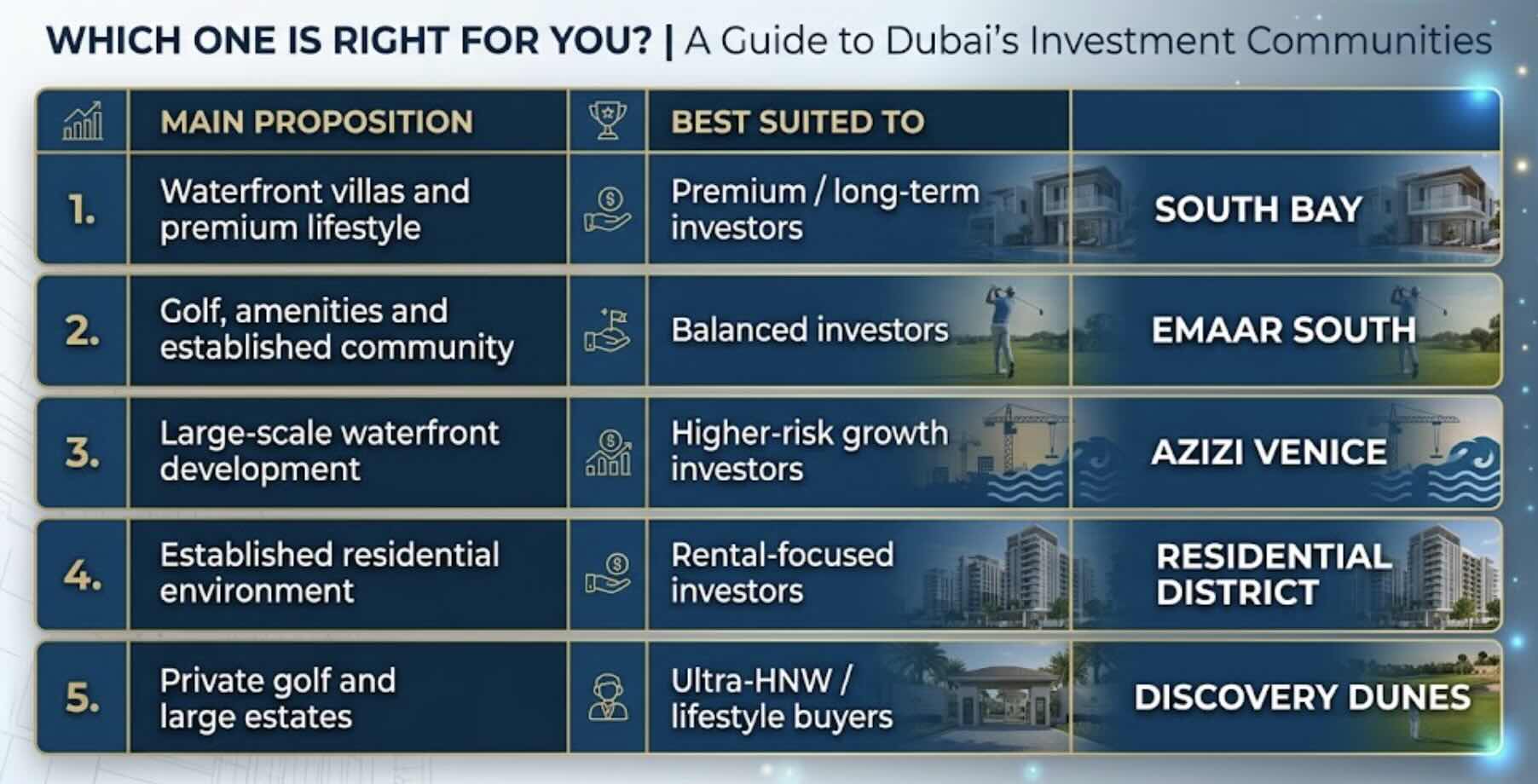
There is no single “best” community in Dubai South. The right choice depends on whether the priority is rental income, capital growth, an established community, or premium positioning.
South Bay
South Bay is one of Dubai South’s premium residential developments, part of the Residential District and built by the same master developer, Dubai South Properties. It’s centred around a 1-kilometre crystal lagoon and a 3-kilometre waterfront promenade, with a mix of villas, townhouses and waterfront mansions.
Best suited to: Investors targeting premium properties and longer-term capital growth.
Emaar South
Emaar South is one of the area’s most established residential communities, developed by Emaar. It offers apartments, townhouses and villas alongside an 18-hole championship golf course, parks and growing retail and dining amenities.
Best suited to: Investors looking for a recognised developer, established community and a more balanced rental and resale proposition.
Azizi Venice
Azizi Venice is a large-scale waterfront development by Azizi Developments, built around an 18-kilometre artificial lagoon, with residential, retail and entertainment components including a 700-metre retail boulevard. Its appeal is primarily based on future development and the scale of the planned community.
Best suited to: Investors comfortable with higher off-plan and development risk.
Residential District
The Residential District is the more established, practical residential side of Dubai South, with more than 25,000 residents, parks, sports facilities, retail, a hypermarket and other everyday amenities. South Bay sits within this district as its premium enclave.
Best suited to: Investors prioritising rental demand, accessibility and an existing residential environment.
Discovery Dunes
Discovery Dunes is a private, members-only golf community developed by Discovery Land Company, centred around a Tom Fazio-designed 18-hole course that has now opened for member play, with fewer than 340 residential plots and an ultra-luxury positioning.
Best suited to: High-net-worth buyers prioritising exclusivity and lifestyle rather than conventional rental yield.
Two properties in the same wider area can have very different developers, completion dates, service charges, tenant profiles and resale prospects. Investors should therefore evaluate the specific project and unit rather than buying simply because it carries the Dubai South name.
6. Why Invest in Dubai South?
The case for investing in Dubai South can be summarised in five factors: infrastructure-led growth, relatively accessible entry prices, potential rental income, flexible payment structures and a range of investment strategies.
1. Infrastructure-Led Growth
Major airport and infrastructure projects are being developed while Dubai South is still maturing. Investors are therefore entering before the district reaches its planned scale, although this also means accepting development and timing risk.
2. Accessible Entry Prices
Dubai South remains relatively affordable by Dubai standards, with some apartments available around or below AED 1 million, while larger villas and premium waterfront properties occupy higher price brackets.
The lower entry price can be attractive, but it should not be considered a substitute for proper property analysis.
3. Rental Potential
Indicative market data suggests gross yields of around 7–8% for some apartments, although actual returns vary significantly between projects and units.
Investors should calculate the expected net yield after service charges, maintenance, vacancy and management costs.
4. Flexible Payment Structures
Some off-plan developments offer staged payment plans, including structures that extend beyond handover. This can reduce the capital required upfront and spread payments over several years.
However, a payment plan does not make a property cheaper or reduce investment risk. It simply changes when the investor pays.
5. Different Investment Strategies
The area offers rental-focused apartments, established golf communities, premium waterfront developments, and higher-risk off-plan opportunities.
This gives investors flexibility, but it also reinforces the importance of selecting the right project rather than investing simply because a property is located in Dubai South.
7. Risks and Objections
Dubai South’s growth story is compelling, but a strong master plan does not guarantee a strong property return. The same development cycle that creates the opportunity also creates several risks worth weighing before buying.
Airport Noise and Construction
Proximity to Al Maktoum International Airport can mean aircraft noise, traffic, and also ongoing construction.
The actual impact on any given property depends heavily on its distance from the runway corridors and flight paths, so buyers should assess the specific project’s location rather than assuming proximity to Dubai South is automatically a plus.
Off-Plan and Delivery Risk
A large proportion of Dubai South’s current transactions are off-plan. This provides access to new projects and payment plans, but also exposes investors to developer and construction risk.
Completion dates can change, infrastructure can take longer than expected, and the finished community may differ from the original marketing proposition. Developer track record and delivery history should therefore be part of the investment analysis.
Future Supply
Dubai South is planned as a major economic and residential district, which means substantial amounts of new housing will continue to enter the market.
If large numbers of similar properties are delivered at the same time, landlords could face greater competition for tenants and sellers could face more competition when exiting. Investors should therefore look for properties with a clear point of differentiation, such as location, views, amenities, community maturity or developer quality.
The Growth Story Is Already Partly Priced In
Dubai South is no longer an undiscovered market. The airport expansion and wider development plans are well known, and strong off-plan activity shows that investors are already positioning themselves for future growth.
Buying simply because “Dubai South will be the next big area” is therefore not enough. The current price needs to leave sufficient room for future appreciation after accounting for development, supply and market risks.
Not Every Dubai South Property Is Equal
Ultimately, Dubai South should not be treated as one investment product. A completed apartment, a new off-plan development and a premium villa can have very different rental, resale and risk profiles. The area may have a strong long-term investment thesis, but the individual property still has to make sense on its own terms.
8. The Bottom Line: Is Dubai South a Good Investment?
Dubai South is not a finished community, and that is both its biggest attraction and its biggest risk.
The investment case is based on what the area is becoming. Al Maktoum International Airport is undergoing a major expansion, while Dubai South is developing as a wider centre for aviation, logistics, business and residential activity. Property demand is already significant, but much of the market remains off-plan, and the area will take years to mature.
For investors with a 5–10 year horizon, this creates a credible opportunity to participate in the growth of one of Dubai’s major emerging corridors. However, Dubai South is not a “buy anything and wait” market.
The strongest approach is to start with the investment objective, then select the community, project, and individual property that best fits it. Rental income, capital growth, developer quality, completion timeline, service charges, and future supply all need to be considered.
Dubai South has many of the ingredients investors look for: major infrastructure investment, a growing economic base, relatively accessible entry prices, and potentially attractive rental yields. What it does not offer is certainty.
For investors prepared to take a longer-term view and accept development risk, Dubai South deserves serious consideration. The opportunity is not simply that the area will grow, but that some properties may benefit more than others as that growth becomes reality.
If you’re weighing specific projects, we’re happy to walk through which ones currently offer that room.


