
If you’re buying an off-plan property in Dubai, Oqood is one of the first documents you’ll encounter after signing your Sale and Purchase Agreement (SPA). While the name may sound unfamiliar, its purpose is relatively straightforward.
Put simply, if you’re buying an off-plan property, you’ll typically encounter Oqood. If you’re buying a completed property, you’ll usually receive a Title Deed instead. Understanding this distinction makes the rest of the buying process much easier to follow.
Oqood, which means “contracts” in Arabic, is Dubai’s official system for registering the sale of off-plan properties with the Dubai Land Department (DLD). When a developer registers your purchase through Oqood, your details and the details of your property are recorded in the DLD’s Interim Real Estate Register.
In simple terms, Oqood is an official record confirming that your off-plan purchase has been registered while the property is still under construction. It provides official recognition of your interest in the property before a final Title Deed can be issued.
For many overseas buyers, this is where confusion begins. Receiving an Oqood registration does not mean you own a completed property. Instead, it confirms that your purchase has been officially recorded with the Dubai Land Department while the project is still being built.
Once construction is complete, the property has been handed over, and the applicable legal and contractual requirements have been met, the Oqood registration is replaced by a Title Deed, which becomes the official record of ownership for the completed property.
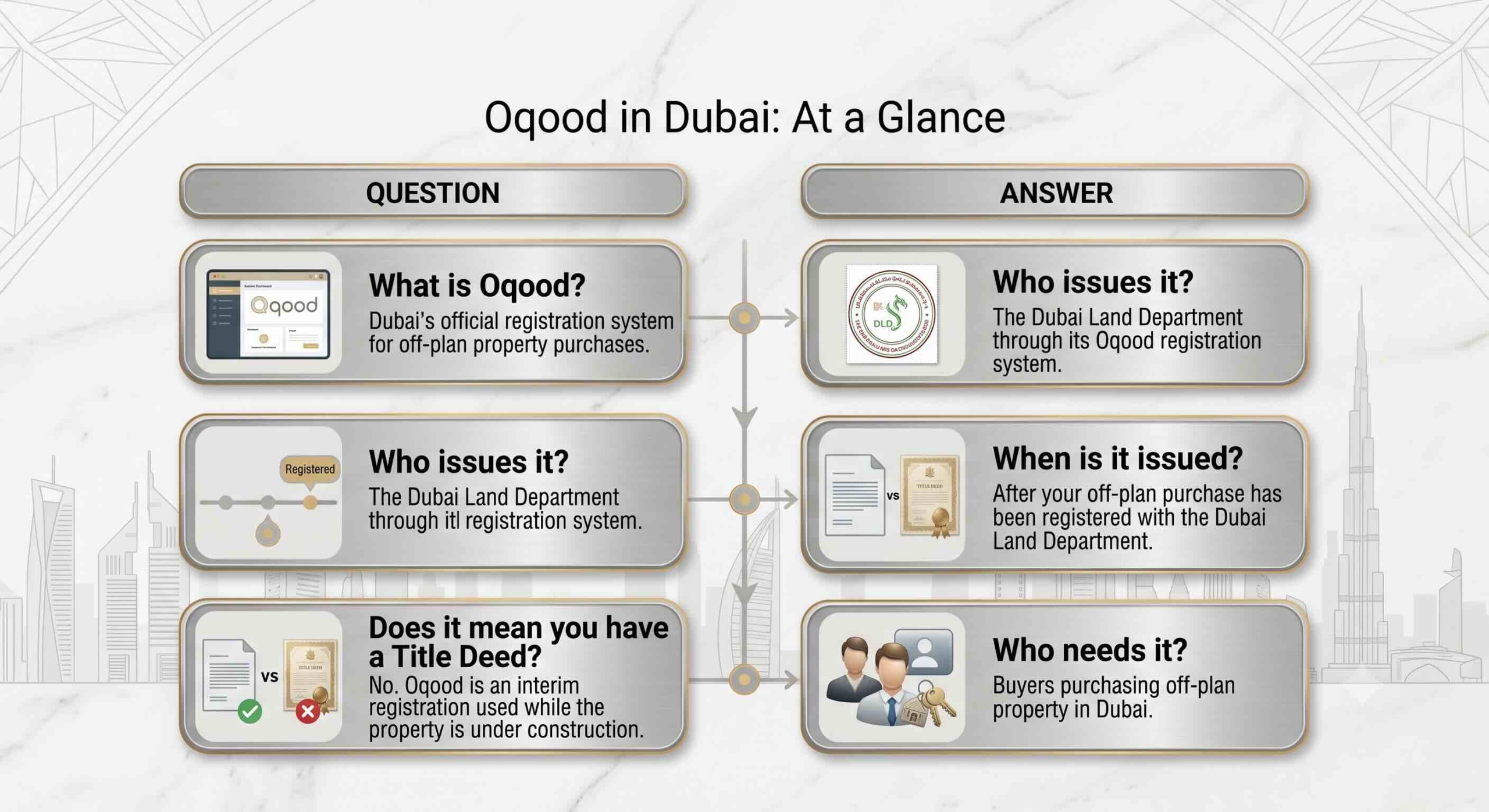
At a glance
Why Was Oqood Introduced?
Dubai’s property market has grown rapidly over the past two decades, with off-plan developments becoming a major part of the city’s real estate sector. As more buyers began purchasing properties before construction was complete, there was a growing need for a system that could officially record these transactions and provide greater transparency.
Before the introduction of Oqood, buyers relied primarily on their Sale and Purchase Agreement (SPA) as evidence of their purchase. While the SPA is a legally binding contract between the buyer and the developer, it did not provide the same level of public registration as a completed property’s Title Deed.
To address this, the Dubai Land Department (DLD) introduced the Interim Real Estate Register, commonly known as the Oqood system. Its purpose is to record off-plan property sales before a project is completed, creating an official government record of the transaction.
This benefits both buyers and the wider property market in several ways.
It creates an official record of your purchase
Once your purchase is registered through Oqood, the Dubai Land Department records your interest in the specific unit you have chosen. Rather than relying solely on a private contract with the developer, your purchase is recognised within the official property registration system.
It improves transparency
Every registered off-plan sale becomes part of the DLD’s Interim Real Estate Register. This helps create a clearer record of ownership interests while developments are still under construction, giving buyers greater confidence that their purchase has been properly recorded.
It helps prevent duplicate sales
One of the key advantages of registering off-plan transactions is that each unit can be linked to a registered buyer. This significantly reduces the risk of the same property being sold multiple times, strengthening confidence in Dubai’s off-plan market.
It supports a more regulated property market
Oqood forms part of Dubai’s wider property registration framework, which aims to improve transparency, accountability and investor confidence. Together with the oversight of the Dubai Land Department and the Real Estate Regulatory Agency (RERA), it helps create a more structured process for buying off-plan property.
That said, it’s important to understand what Oqood is designed to do. It records your purchase with the Dubai Land Department, but it does not guarantee that a project will be completed on schedule or eliminate the normal risks associated with property development. Like any real estate investment, factors such as construction progress, market conditions and the developer’s performance can still affect the outcome.
Do You Actually Need Oqood?
The short answer is yes, if you’re buying an off-plan property in Dubai.
If you’re purchasing a property that is still under construction directly from a developer, your transaction will normally be registered through the Dubai Land Department’s Oqood system. This ensures your purchase is officially recorded while the property is being built and before a final Title Deed can be issued.
You will usually need Oqood if you are:
- Buying an off-plan apartment, villa or townhouse from a developer.
- Purchasing an eligible off-plan property from another buyer before completion (commonly known as an assignment sale).
In these situations, the property is still under construction, so a Title Deed has not yet been issued. Instead, your purchase is registered through Oqood until the project is completed and ready for handover.
You generally do not need Oqood if you are:
- Buying a completed property that already has a Title Deed.
- Purchasing a resale property through the standard Dubai Land Department transfer process.
In these cases, ownership is transferred directly with a Title Deed rather than through the Oqood registration system.
A simple example
Imagine two buyers purchasing property in Dubai on the same day.
Buyer A purchases a completed apartment in Dubai Marina. The apartment already has a Title Deed, so once the transaction is completed, ownership is transferred directly into the buyer’s name through the Dubai Land Department.
Buyer B purchases a new apartment in an off-plan development that is still under construction. Because the building has not yet been completed, there is no Title Deed for that unit. Instead, the purchase is registered through Oqood. Once the project is completed and the applicable requirements have been met, the buyer becomes eligible to receive a Title Deed.
Although both buyers are purchasing property in Dubai, only the buyer of the off-plan property goes through the Oqood process.
Where Oqood Fits in the Buying Process
Buying an off-plan property in Dubai involves several stages, and Oqood is just one part of that journey. Understanding where it fits can help you know what to expect and avoid confusion when your developer requests documents or registration fees.
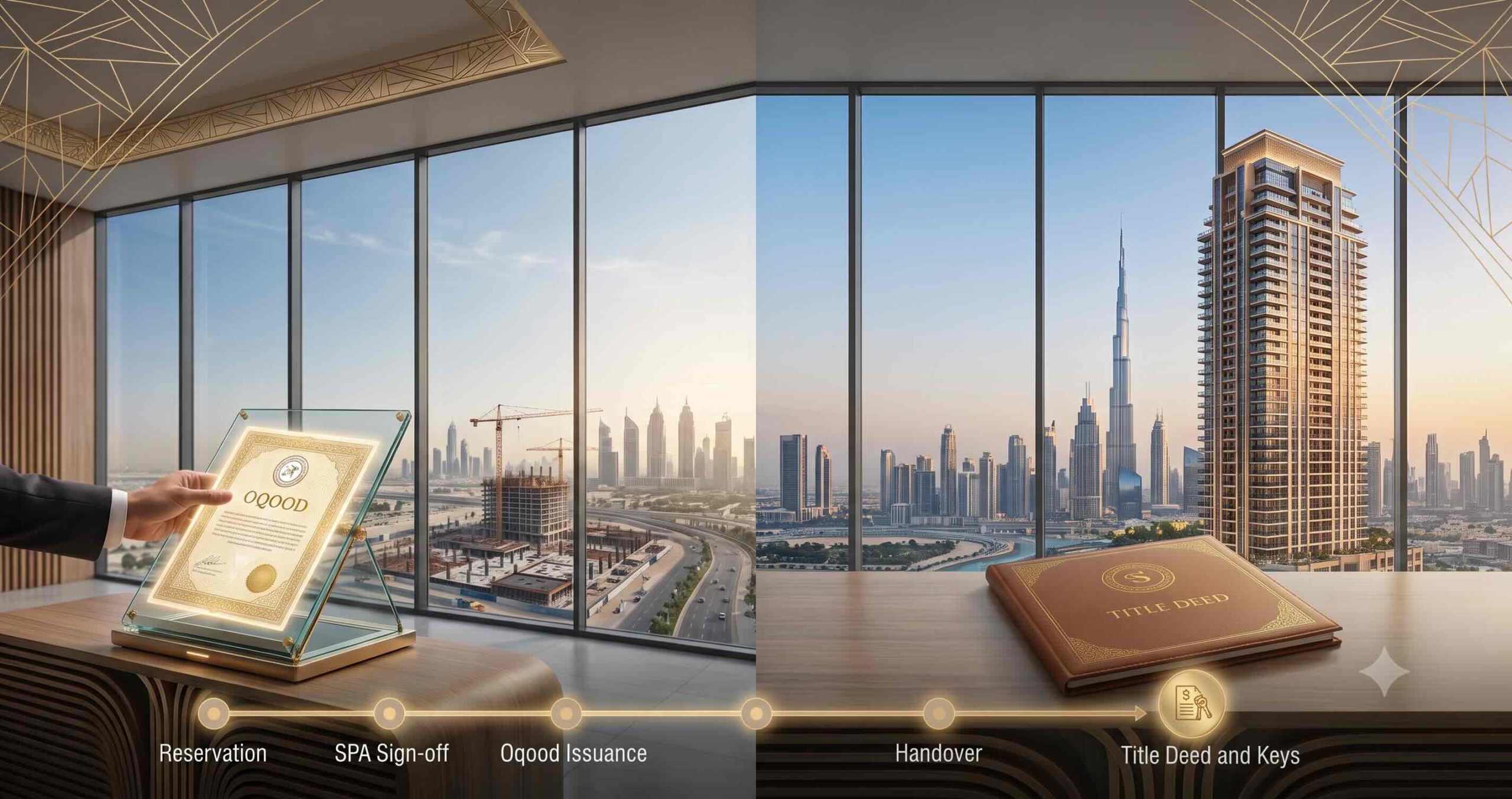
The simplified timeline below shows how a typical off-plan purchase progresses.
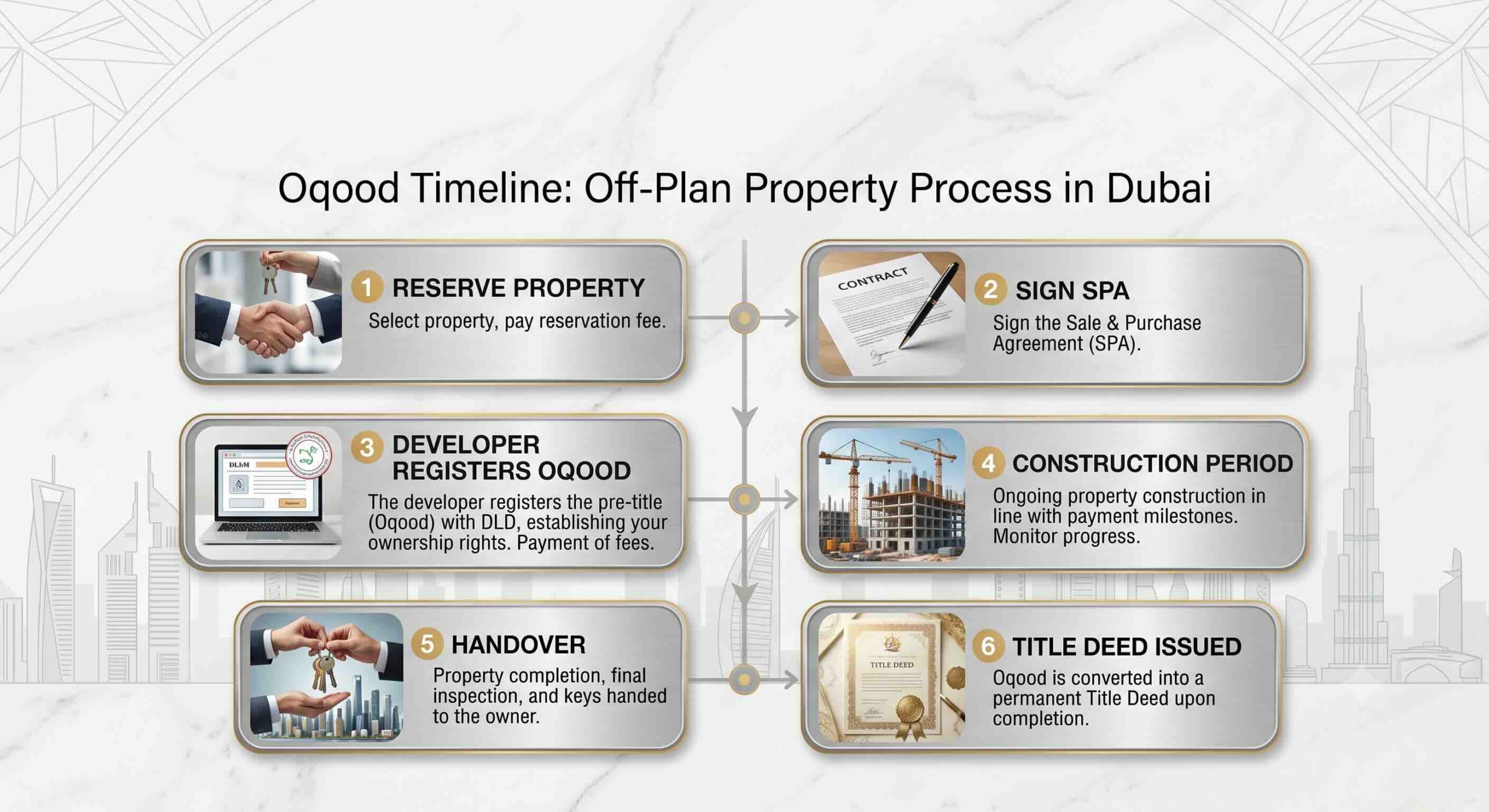
Let’s look at each stage in more detail.
1. Reserve your property
Once you’ve chosen a property, you’ll usually pay a reservation or booking fee to secure the unit. The developer will provide details of the property, the purchase price and the payment plan.
At this stage, you’ve reserved the property, but the purchase has not yet been formally registered with the Dubai Land Department.
2. Sign the Sale and Purchase Agreement (SPA)
The Sale and Purchase Agreement, commonly known as the SPA, is the legal contract between you and the developer. It sets out the key terms of the purchase, including the agreed price, payment schedule, estimated completion date and the rights and obligations of both parties.
Signing the SPA is an important milestone, but it is only the beginning of the registration process.
3. Your purchase is registered through Oqood
After the SPA has been signed and the developer has completed the necessary registration process, your off-plan purchase is recorded with the Dubai Land Department through the Oqood system.
This is the point at which your purchase becomes part of the DLD’s Interim Real Estate Register.
For many buyers, this is the first official confirmation that their off-plan purchase has been registered.
4. Construction continues
While the project is under construction, you’ll normally continue making payments according to the schedule agreed in your SPA.
During this period, your Oqood registration remains the official record of your registered interest in the property until the development is completed.
5. Handover and completion
Once construction has been completed and the project has met the necessary regulatory requirements, the developer prepares the property for handover.
Before taking possession, buyers typically complete any remaining contractual requirements, such as settling outstanding payments in accordance with their SPA.
6. The Title Deed is issued
After the applicable completion and registration requirements have been satisfied, the Dubai Land Department can issue the property’s Title Deed.
At this stage, the purchase moves beyond the interim registration provided by Oqood, and the Title Deed becomes the official record of ownership for the completed property.
Why Oqood Matters
Although Oqood doesn’t make you the legal owner of a completed property, it plays an important role in Dubai’s off-plan property market.
By registering your purchase with the Dubai Land Department, Oqood provides an official government record of your transaction while the property is still under construction. This creates greater transparency and helps distinguish registered purchases from private contractual agreements alone.
For overseas buyers, this official registration can provide additional confidence that their purchase has entered Dubai’s property registration system.
However, Oqood should not be confused with a guarantee.
It does not guarantee that:
- construction will finish on schedule
- the property’s value will increase
- the investment is risk-free
As with any off-plan purchase, buyers should also consider the developer’s track record, payment plan, location and long-term investment objectives.
Can You Sell an Off-Plan Property Before Completion?
Yes, in many cases you can. Selling an off-plan property before handover is commonly known as an assignment sale.
However, registering your purchase through Oqood does not automatically give you the right to transfer or sell your interest whenever you choose. Oqood records your off-plan purchase with the Dubai Land Department while the property is under construction, but the ability to sell before completion depends on the terms of your Sale and Purchase Agreement (SPA), the developer’s requirements and the applicable Dubai Land Department procedures.
If you’re considering selling before handover, always review the conditions that apply to your purchase before agreeing. Oqood records your purchase, not your right to resell it. Whether you can complete an assignment sale depends on your SPA, the developer’s requirements and the applicable Dubai Land Department procedures.
Common Mistakes Buyers Make About Oqood
Buying an off-plan property in Dubai is generally a straightforward process, but many first-time buyers misunderstand the role of Oqood. These misconceptions can lead to unrealistic expectations or unnecessary concern during the purchase journey.
Here are some of the most common mistakes and how to avoid them.
Mistake 1: Thinking Oqood is the same as a Title Deed
This is the most common misconception. Oqood records an eligible off-plan purchase while the property is under construction. A Title Deed is issued later and becomes the official record of ownership once the property is complete.
If you remember one thing from this article, it’s this: Oqood comes before the Title Deed, not instead of it.
Mistake 2: Assuming Oqood means the project is guaranteed
Oqood records your purchase, but it doesn’t eliminate the normal risks associated with buying an off-plan property.
Mistake 3: Not Reading the Sale and Purchase Agreement (SPA)
Many buyers focus on the payment plan and purchase price but spend very little time reviewing the Sale and Purchase Agreement (SPA). Taking the time to understand your SPA can help you avoid misunderstandings later in the buying process. If there’s anything you’re unsure about, seek clarification from the developer or an appropriately qualified professional before signing.
Mistake 4: Assuming Every Dubai Property Has Oqood
Not every property purchase in Dubai goes through the Oqood system.
If you’re buying a completed apartment or villa that already has a Title Deed, Oqood usually isn’t part of the transaction.
Oqood is primarily associated with eligible off-plan property purchases.
Mistake 5: Focusing Only on Oqood
Oqood is an important part of the buying process, but it shouldn’t be the only factor you consider.
Before investing in an off-plan property, it’s equally important to evaluate:
- the developer’s track record
- the location and long-term growth potential
- the payment plan
- estimated completion timelines
- your own investment objectives
Experienced investors look at the bigger picture rather than relying on a single document as an indicator of investment quality.
Final Thoughts
Buying an off-plan property in Dubai involves more than simply choosing the right home or investment. It also means understanding the key milestones that take you from signing a contract to becoming the legal owner of a completed property.
Oqood is one of those milestones. Rather than replacing a Title Deed, it records your off-plan purchase with the Dubai Land Department while the property is under construction. Once the development has been completed and the applicable legal and contractual requirements have been met, the Title Deed becomes the official record of ownership.
Understanding the role of Oqood helps set realistic expectations and gives you greater confidence throughout the buying journey, from reservation and registration through to handover.
If you’re considering buying an off-plan property in Dubai, Luxe Nautilus Realty can provide clear, straightforward guidance at every stage of the process. Contact us to discuss your property goals with one of our property agents.