

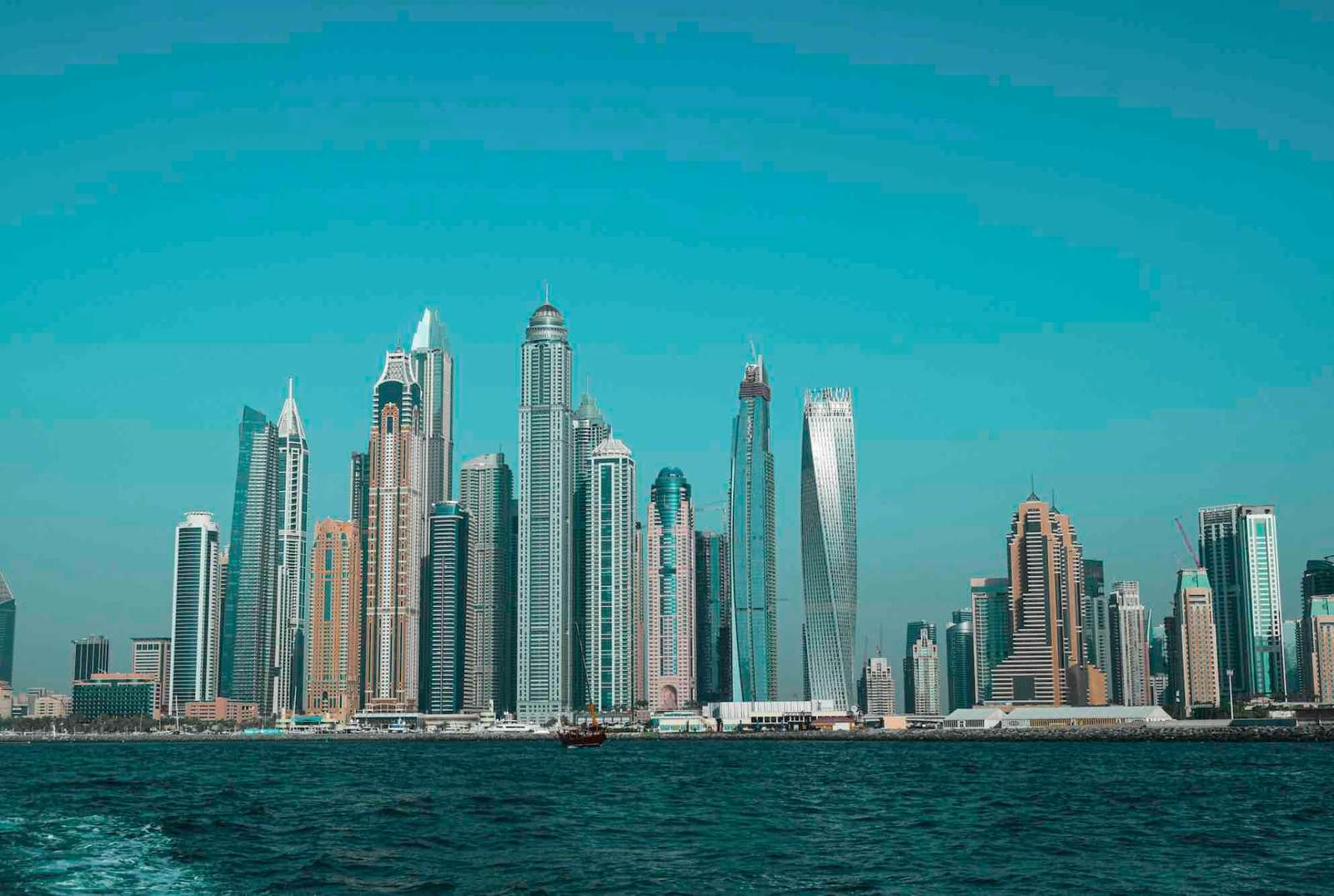
Most people don’t struggle to buy property in Dubai because the process is complicated.
They struggle by underestimating cash required, trusting the wrong people, or choosing the wrong area, mistakes that are expensive to fix once realised.
This guide walks you through the real buying process in 2026. You’ll understand what you need to pay, what can go wrong, and how to avoid the mistakes most buyers make.
Why Dubai Still Makes Sense in 2026
Dubai continues to attract property buyers from around the world for a few simple reasons.
First, there is no property tax, no capital gains tax, and no tax on rental income. For many international buyers, this alone makes a significant difference to long-term returns.
Second, rental yields are still strong. In many areas, returns range between 5% and 9%, which is higher than what you would typically see in cities like London or Singapore.
Finally, the market is well-regulated. The Dubai Land Department (DLD) and RERA oversee transactions, which creates a structured and transparent system compared to many emerging markets.
Step-by-Step Process to Buy Property in Dubai
Step 1: Define Your Goal Before You Start
Before you look at any property, you need to be clear about why you are buying. If you are buying a home, focus on lifestyle, location, and comfort. For rental income, prioritise yield, service charges, and tenant demand. For capital growth, consider future infrastructure and long-term demand.
Many buyers try to achieve all three at once. In reality, this usually leads to average results across the board. The smarter approach is to prioritise one goal and let it guide your decisions.
Step 2: Understand the Rules for Foreign Buyers
Dubai is one of the most accessible property markets in the world for foreign buyers. You do not need residency or a UAE visa to purchase property.
However, you can only buy in designated freehold areas. These are zones where you fully own the property with no time limit. Popular examples include Downtown Dubai, Dubai Marina, Palm Jumeirah, Jumeirah Village Circle, Business Bay, Dubai Hills Estate, Arabian Ranches, and Jumeirah Lake Towers.
Before moving forward with any property, always confirm that it is located in a freehold area.
Step 3: Understand the Real Cost
This is where most buyers make mistakes. The price you see listed is not the total amount you will pay. In most cases, you should budget an additional 7% to 10% on top of the property price to cover fees and closing costs.
For example, if you are buying a property for AED 1.5 million, you should expect to pay roughly AED 110,000 to 130,000 extra.
If you are using a mortgage, your upfront cash requirement becomes even higher. Typically, you will need between 26% and 30% of the property value in cash. Since recent regulations, banks do not finance these additional costs, so they must be paid out of pocket. This is one of the main reasons buyers delay or fail to complete their purchase.
For a full breakdown of all costs, see our guide to buying property in Dubai.
Step 4: Sort Your Finances Early
Once you understand the costs, the next step is to organise your finances. If you are paying in cash, your total budget should include both the property price and all additional fees. If you are using a mortgage, you need to understand how much you can borrow before you start viewing properties.
In general, expat residents buying their first home under AED 5 million can borrow up to 80%. Investment properties usually qualify for around 60%, while non-residents are typically limited to 50–60%, depending on the bank.
It is also important to note that your total monthly debt obligations cannot exceed 50% of your income. Getting a mortgage pre-approval early not only saves time but also shows sellers that you are a serious buyer.
You can explore different mortgage options available in Dubai
Step 5: Choose the Right Area
Dubai is not a single market. Each area behaves differently, and choosing the wrong one can affect both your returns and your exit options. If your focus is on rental income, more affordable communities with strong tenant demand tend to perform better. Areas like Jumeirah Village Circle, Jumeirah Lake Towers, and Dubai Sports City often fall into this category.
If you care more about lifestyle and resale value, locations such as Dubai Marina, Downtown Dubai, and Palm Jumeirah are usually more liquid and easier to sell. For family living, communities like Dubai Hills Estate and Arabian Ranches offer more space, schools, and a quieter environment.
If your goal is a lower entry price or off-plan investment, areas like Dubai South, Arjan, and Dubai Creek Harbour may be worth considering, although they come with higher risk and longer timelines.
Here are the top 13 Neighbourhoods in Dubai you should consider.
Step 6: Work With a RERA-Registered Agent
Every legitimate real estate agent in Dubai is registered with RERA and has a licence number that can be verified. A good agent will take the time to understand your goal, show you multiple options, and help you negotiate effectively. On the other hand, some agents may push specific projects because of higher commissions.
If an agent is only showing you one option without understanding your needs, that is a red flag.
Step 7: Sign the MOU and Pay the Deposit
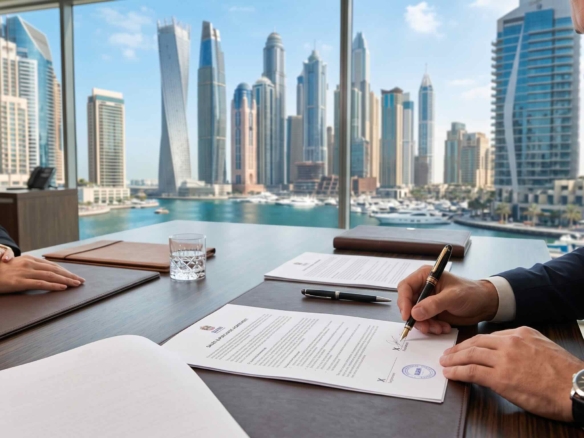
Once you agree on a property, the next step is to sign a Memorandum of Understanding (MOU).
This is a legally binding agreement that sets out the price, terms, and completion timeline of the transaction. At this stage, you will typically pay a 10% deposit.
Because the MOU is binding, it’s important to understand exactly what you are agreeing to before you sign. The deposit is at risk; if you withdraw without a valid reason, you may lose it. If the seller backs out, they are required to compensate you.
For a clearer understanding of your rights, obligations, and the legal framework behind property transactions, see our complete guide to the legal aspects of property ownership in Dubai.
Step 8: Obtain the NOC
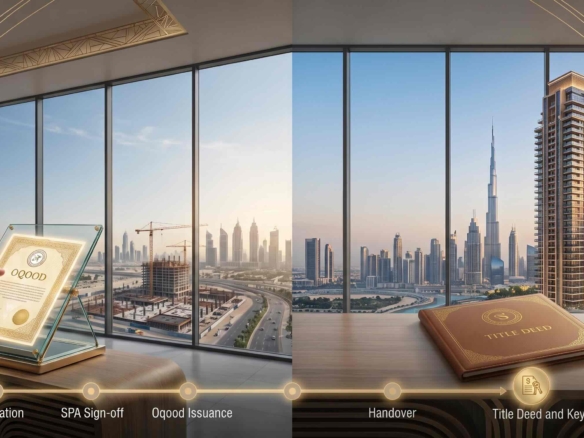
Before the transfer can happen, the developer must issue a No Objection Certificate, or NOC. This document confirms that there are no outstanding payments or issues with the property. Without it, the transaction cannot proceed. The process usually takes anywhere from a few days to two weeks.
Step 9: Transfer Ownership at the DLD
The final transfer takes place at a Dubai Land Department trustee office. During this step, all documents are submitted, payments are completed, and ownership is officially transferred. You will then receive your title deed.
For cash buyers, the process usually takes two to four weeks. Mortgage transactions may take slightly longer.
Step 10: Set Up After Purchase
After receiving your title deed, there are a few final steps to complete. You will need to set up utilities such as DEWA, register for service charge payments, and consider home insurance, especially if you have financed the property.
Common Mistakes Buyers Make
Even in a regulated market like Dubai, mistakes still happen. One of the most common issues is choosing the wrong area for your goal. A property that works well for living may not perform well as an investment.
Another common mistake is ignoring service charges, which can significantly reduce your net return. Many buyers also underestimate upfront costs, which creates financial pressure later in the process.
Working with the wrong agent can lead to poor decisions, especially if they are focused only on commission rather than your needs. Off-plan properties can also face delays, sometimes by 12 to 24 months, depending on the developer. Finally, some properties have low resale demand, which can make it difficult to exit when needed.
Dubai Golden Visa
If your property is valued at AED 2 million or more, you may qualify for a 10-year UAE Golden Visa. This allows long-term residency without the need for employer sponsorship.
Before You Make Your Decision
Buying property in Dubai becomes much simpler when you follow a clear process. Start by defining your goal, then understand your full budget, including all additional costs. Secure your financing early, choose the right area, and work with a licensed agent.
From there, the process moves through signing the MOU, obtaining the NOC, and completing the transfer at the Dubai Land Department. Once ownership is transferred, you can set up utilities and manage your property.
Not Sure Where to Start?
Every buyer’s situation is different, and small decisions can have a big financial impact.
Send us a message through our contact form or chat with us on WhatsApp to arrange a short call. We’ll break down your exact budget, recommend the right areas, and guide you on the next steps, based on your goals.
Updated in 2026

Join The Discussion